







In the pneumatic vs electric gripper decision, pneumatic wins on grip force, speed, durability, and upfront cost. Electric wins on programmable force, exact jaw position, and built-in feedback. Pick pneumatic for high-volume handling, heavy parts, and CNC machine tending. Pick electric for fragile parts, high-mix sorting, cleanrooms, or any site with no compressed air.
That covers the short version. The longer answer depends on one detail most comparisons skip: where the gripper is mounted. A gripper on a robot arm has a real choice between air and electric. A gripper that loads parts from inside a CNC spindle almost never does. We build spindle grippers for a living, so this guide covers both cases, with specs you can check.
Pneumatic vs Electric Gripper at a Glance
Here is the full comparison in one table. Each row is covered in more detail below.
Table: pneumatic grippers vs electric grippers, side by side
| Factor | Pneumatic (air) gripper | Electric (servo) gripper |
|---|---|---|
| Power source | Compressed air through a solenoid valve | 24V DC motor with onboard or external controller |
| Grip force for its size | High | Lower, though improving |
| Open/close speed | Very fast | Moderate |
| Force control | Set by a pressure regulator, not programmable per cycle | Programmable per part, per cycle |
| Jaw position control | Usually full open or full closed | Any point in the stroke |
| Part detection | Needs added sensors (built in on IO-Link models) | Usually built in |
| Upfront cost | Low | Higher |
| Running cost | Compressed air is expensive energy | Lower energy per cycle |
| Maintenance | Seals and wipers on a known service interval | Few wear parts, but more electronics |
| Coolant and chips | Tolerant, simple to seal | Needs a suitable IP rating |
| On loss of power | Depends on normally open or normally closed design | Many hold position with a self-locking drive |
| Best fit | High-volume, heavy parts, CNC tending | High-mix, delicate parts, cleanrooms, no air on site |
The table gives you the pattern. The sections below explain why each row lands where it does.
What Is a Pneumatic Gripper (Air Gripper)?
A pneumatic gripper, also called an air gripper, uses compressed air to drive a piston that opens and closes the jaws. A solenoid valve switches the air on and off. A pressure regulator sets how hard the jaws squeeze. That is the whole control system, which is a big part of why air grippers have been the industrial default for decades.
How an air gripper works
Air enters a cylinder and pushes a piston. A wedge, cam, or rack converts that straight push into jaw motion. In a double-acting gripper, air drives the jaws both open and closed. In a single-acting gripper, air drives one direction and a spring returns them.
Grip force rises with pressure, up to the gripper's rated limit. Turn the regulator up and the part is held tighter. Turn it down and you protect thin walls from marking.
Normally open vs normally closed
This detail matters more than most buyers expect. A normally open (NO) gripper rests with its jaws open and needs air to close. A normally closed (NC) gripper rests clamped and needs air to release. The choice decides what happens to the part when the air drops, which we cover in its own section below.
Common jaw styles
- Parallel grippers: jaws travel straight toward each other. The most common style for machine tending.
- Angular grippers: jaws pivot open. Cheaper and good for clearance, but harder to design around.
- 2-jaw: best for flat and square stock.
- 3-jaw concentric: centers round parts more accurately.
For specs and sizing on the most common style, see our parallel grippers page. The mechanics are simple. The more useful question is what an electric gripper does differently.
What Is an Electric Gripper (Servo-Electric Gripper)?
An electric gripper drives its jaws with a motor instead of air. Most use a small DC servo or stepper motor turning a lead screw, ball screw, or gear train. A controller tells the motor how far to move, how fast, and how hard to push. It runs on 24V DC power and a signal cable, so no air line is needed.
Programmable force, speed, and stroke
You can set grip force per part in software. You can close at full speed, then slow down for the last few millimeters so the jaws touch the part gently. You can also open the jaws only as far as each part needs, which saves cycle time and clearance in tight spaces.
Built-in feedback
Because the controller knows the motor's position, it knows where the jaws stopped. If they closed further than expected, the part is missing or undersized. That gives you part detection and basic gauging with no added sensors.
That control is real and useful. It also costs more, and the force per dollar is lower. So how do the two compare once you put them on a real job?
Electric Gripper vs Pneumatic: 8 Key Differences
Each difference below ends with a plain rule of thumb. Most buying decisions are settled by two or three of these, not all eight.
1. Grip force and power density
Air grippers produce more force for their size and weight. A compact pneumatic body can deliver hundreds of pounds of jaw force. Getting the same force from an electric gripper usually means a larger, heavier, more expensive unit.
Rule of thumb: heavy parts or a tight weight budget on the arm or spindle point to pneumatic.
2. Speed and cycle time
Pneumatic jaws snap open and closed in a fraction of a second. Electric jaws are slower on raw stroke, but they can save time elsewhere by opening only partway. On a high-volume line making the same part all day, raw speed usually wins.
Rule of thumb: one part, high volume, air. Many part sizes, electric can close the gap.
3. Force and position control
This is where electric pulls ahead. A basic air gripper runs at full stroke every time, and force is fixed by the regulator for the whole run. Very low forces are also hard to hold with air, because seal friction makes the jaws stick and jump at low pressure.
Electric grippers set force and position per cycle in the program. If one cell handles a soft plastic part and then a steel blank, electric can switch between them with no hands on a regulator.

Rule of thumb: delicate or mixed parts in the same cell point to electric.
4. Feedback and part detection
A basic pneumatic gripper does not know whether it caught a part. You add a magnetic or proximity sensor on the body to get that signal. IO-Link pneumatic grippers close part of this gap by adding position sensing and diagnostics, at a higher price.
Electric grippers report jaw position by default, so "did we grip the part?" comes free.
Rule of thumb: if your process needs to prove every pick, electric or IO-Link pneumatic.
5. Upfront cost
Air grippers cost less to buy. Our own pneumatic spindle grippers start at $1,379, complete with fingers, plates, and pads. Electric grippers with comparable stroke generally cost more, before you add the controller and cabling.
Rule of thumb: on purchase price alone, pneumatic wins clearly.
6. Operating cost and energy
Compressed air is one of the most expensive forms of energy in a shop. U.S. Department of Energy guidance puts it at roughly 7 to 8 hp of electricity to run a 1 hp air motor, with whole-system efficiency as low as 10 to 15%. Leaks make that worse.
Here is the honest part most comparisons skip. A single gripper uses very little air per cycle. If your shop already runs a compressor for vises, blow-offs, and tool changers, one more gripper barely moves the bill. The energy argument matters when you are deciding on dozens of grippers across a plant, or building a site with no compressor at all.
Rule of thumb: already have shop air? Running cost rarely decides it. No air? Electric saves you a whole system.
7. Maintenance and service life
Pneumatic grippers wear seals and wipers, on a predictable schedule. Our fourth-generation GimGripper4 is rated to 2,000,000 actuations, with service recommended every 250,000 cycles. Ask any vendor for numbers like these in writing, for either type.
Electric grippers have fewer wear parts, but they add motors, encoders, connectors, and cables. When they fail, the fix is usually a swap, not a seal kit.
Rule of thumb: pneumatic is easier to service in-house. Electric needs less routine service but harder repairs.
8. Environment: coolant, chips, cleanrooms
Air grippers tolerate dirty, wet environments well. The air inside the body even pushes contaminants outward. That is one reason they dominate machining.
Electric grippers need an IP rating that matches the environment. Flood coolant and chips are hard on connectors and seals. In a cleanroom the picture flips: exhaust air from a pneumatic valve can carry oil mist and particles, so electric is the safer choice.
Rule of thumb: wet and dirty, pneumatic. Clean and controlled, electric.
Those eight points cover the robot-arm decision well. They leave out one question that matters more for unattended work: what the gripper does when the power goes out.
What Happens When Air or Power Is Lost?
Picture a lights-out run at 2 a.m. The compressor trips. What does the gripper do with the part it is holding?
For pneumatic grippers, the answer depends on the design:
- Normally open: the jaws relax and the part can drop.
- Normally closed or spring-assisted: the spring keeps the jaws clamped.
- Mechanical self-lock or check valve: traps pressure or force and holds the part for a period.
For electric grippers, many designs use a self-locking screw or a brake, so the jaws hold their position when power is cut. Not all do. Check the datasheet for a holding-force rating at zero power.
Here is how we handle it on our own products. Our GimGripper4 spindle grippers are normally open. They close on air or coolant and open when it is shut off. That works because a spindle gripper only holds a part for a few seconds while it moves over the vise. During cutting, the part sits in the vise, not the gripper. That is why our AutoVise pneumatic vises use spring retention that keeps the part clamped if air pressure drops.
The lesson: judge air-loss safety for the whole cell, not just the gripper. That leads straight to the question of where the gripper lives.
Why Almost Every CNC Spindle Gripper Is Pneumatic
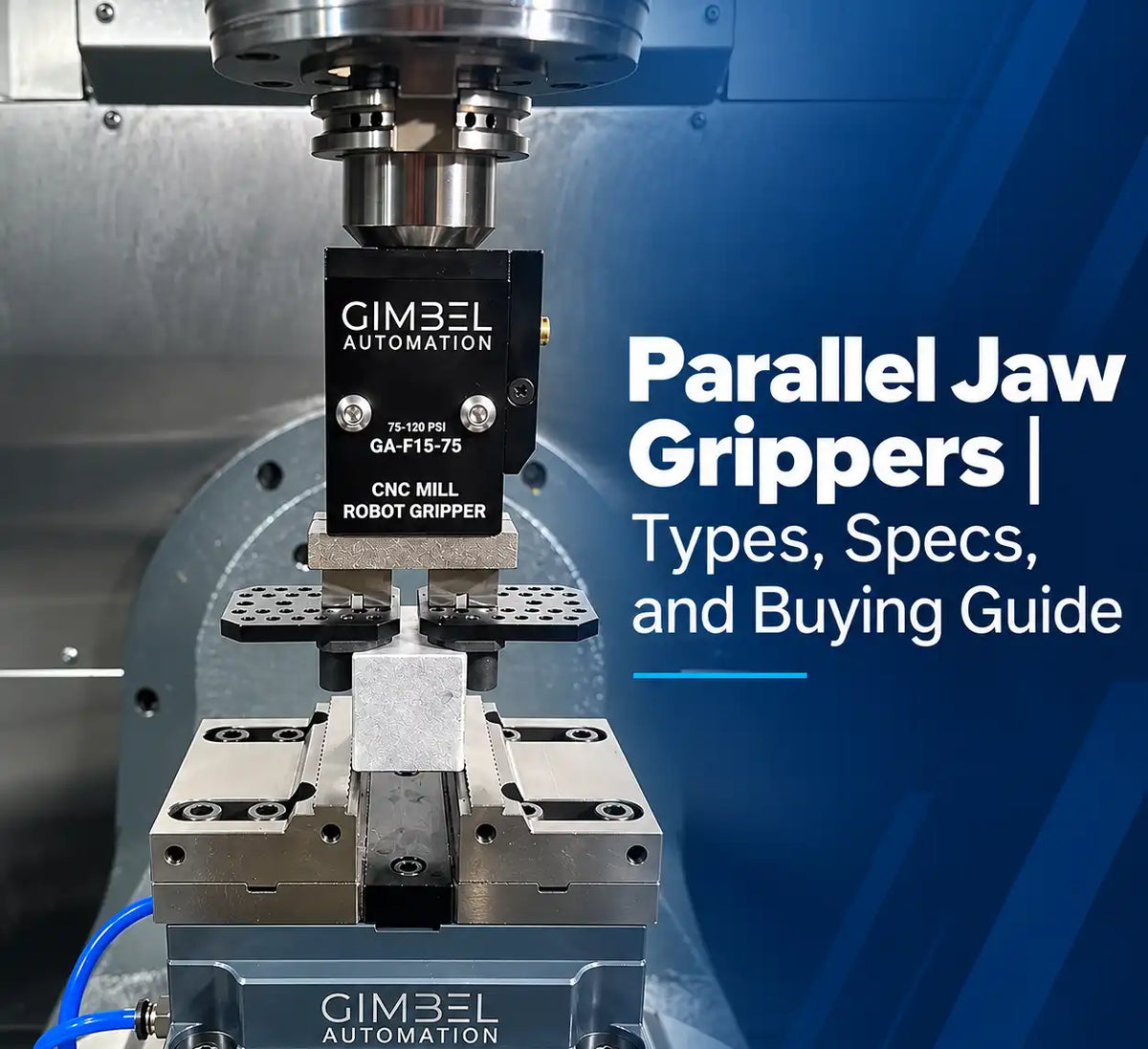
Most pneumatic vs electric gripper guides assume the gripper hangs off a robot arm. In CNC machine tending there is another option: put the gripper in the machine's own spindle. The gripper sits in the automatic tool changer (ATC) like any other tool holder. When the program calls it, the spindle picks it up, and the machine's own X, Y, and Z axes move the part. No robot required.
Once the gripper lives in the spindle, the air vs electric choice is mostly made for you.

Air and coolant already pass through the spindle
Many vertical machining centers have through-spindle air (TSA) or through-spindle coolant (TSC). Both send fluid down the center of the spindle and out through the tool holder. A spindle gripper can use that same path as its power source. Switch on through-spindle air with an M-code and the jaws close. Switch it off and they open.
Our CNC grippers use a 3/4" shank, so they fit standard holders in CAT40, BT30, and similar tapers. Each one uses a single tool slot.
The ATC problem for electric grippers
Electrical power has no standard path through a spindle. A tool holder locks into the taper by its pull stud, and there are no electrical contacts at that connection. The spindle is also built to rotate, not to carry cables.
An electric spindle gripper would need an onboard battery and a wireless signal, much like a spindle probe. That adds cost, charging, and another thing to fail inside a coolant-soaked work envelope. For a tool that changes in and out of the spindle all day, that is a poor trade.
The third option: coolant-actuated grippers
Here is something most guides never mention. A gripper can run on coolant instead of air. Our Coolant GimGripper4 closes its jaws using through-spindle coolant pressure, rated across a 120 to 400 psi range. The holder vents pressure so the gripper actuates cleanly.
That matters because many shops have TSC but not TSA. With a coolant-actuated gripper, they can automate without adding an air system to the spindle. The fluid that cools the tool also drives the jaws.
No through-spindle air or coolant?
Older and entry-level machines often have neither. For these, our FloLink grippers feed shop air into the gripper from the side through a manifold block with an integrated rotary union. That still lets the spindle orient the gripper to any angle with M19, so parts can be rotated or re-oriented during the load.
So for in-machine automation, pneumatic is a structural fit, not a preference. The more useful question becomes which parts and jobs suit each type.
Best Applications for Each Gripper Type
Pneumatic grippers earn their place where force, speed, and toughness matter. Electric grippers earn theirs where control and cleanliness matter.
Where pneumatic grippers fit best
- CNC machine tending: loading raw stock and unloading finished parts, in or out of the spindle.
- Heavy parts: our standard GimGripper4 handles parts up to 10 lb, and the High Force version handles up to 40 lb.
- High-volume pick and place: the same part, all shift.
- Two-operation automation: gripper, flip station, and two vises running op 1 and op 2 in one cycle.
- Wet, dirty environments: coolant, chips, bead blast.
Flat parts with no good gripping edge are another case. A vacuum gripper often does better there. Our GimVac3 makes vacuum from through-spindle air with a venturi and picks parts up to 25 lb.
Where electric grippers fit best
- High-mix sorting: many part sizes through one cell.
- Fragile parts: glass, thin plastics, electronics, rubber.
- Cleanrooms: medical, pharma, and semiconductor work where exhaust air is a problem.
- Mobile robots and cobots on carts: no air hose to drag around.
- Sites with no compressed air: one less utility to install.
A two-op cycle on one machine
Here is a typical in-machine setup we build. The spindle picks a blank from a tray and loads it into the first-op vise. The machine cuts op 1. The gripper moves the part to a pneumatic flip station, which turns it 180 degrees. The gripper regrips it and loads it into the second-op vise for the remaining features.
Every motion in that cycle runs on air: gripper, flipper, and both vises, all switched by M-codes from the CNC program. There is no robot to program and no cell to fence. That is the kind of job where the pneumatic vs electric gripper question answers itself.
Your job may not be that clear-cut. A short checklist settles most of the rest.
How to Choose: A 6-Question Checklist
Work through these in order. The first "yes" or "no" that rules something out usually settles it.
- Check your air supply. No clean, regulated shop air on site? Electric saves you a whole system. Already have it? Pneumatic stays on the table.
- Define your part mix. Low-mix, high-volume work favors pneumatic. High-mix work with frequent changeovers favors electric.
- Weigh the part. Heavy blanks, or a tight payload limit, push you toward pneumatic for its force per pound.
- Decide if you need proof. If every pick must be verified, choose electric or a pneumatic gripper with IO-Link or sensors.
- Locate the gripper. On a robot arm, both are valid. In a CNC spindle, pneumatic or coolant-actuated is the practical route.
- Plan for power loss. Decide what must hold the part if air or power fails, and confirm it on the datasheet.
The verdict by scenario:
| Your situation | Best fit |
|---|---|
| One CNC, repeat parts, want unattended runs | Pneumatic spindle gripper |
| CNC with TSC but no through-spindle air | Coolant-actuated spindle gripper |
| CNC with neither TSA nor TSC | Pneumatic gripper fed by a side manifold |
| Cobot tending several machines, mixed parts | Electric gripper on the arm |
| Fragile parts or a cleanroom | Electric gripper |
| Heavy blanks, high volume, robot arm | Pneumatic gripper on the arm |
Most small and mid-size CNC shops land in the first three rows. If you want to see what fits your exact machine, the free 3D CNC configurator lays out grippers and vises on your table in a few minutes.
Frequently Asked Questions
Are pneumatic grippers stronger than electric grippers?
Yes, for their size. A pneumatic gripper produces more grip force per pound of gripper and per dollar. Electric grippers are closing the gap, but matching high force with electric usually means a bigger, more expensive unit.
Air gripper vs electric gripper: which is cheaper over time?
The air gripper costs less to buy. Electric uses less energy per cycle, since compressed air takes roughly 7 to 8 hp of electricity per 1 hp of work. If your shop already runs a compressor, one more air gripper adds little cost. If you would need to install air just for the gripper, electric is often cheaper overall.
Can a pneumatic gripper detect if it picked a part?
Not on its own. A basic air gripper needs a magnetic or proximity sensor to confirm jaw position. IO-Link pneumatic grippers build this in. Electric grippers detect it by default through motor position.
Can you use an electric gripper in a CNC tool changer?
Not practically. A tool holder has no electrical contacts at the taper, so an electric gripper in the spindle would need an onboard battery and wireless control. That is why spindle grippers run on through-spindle air, through-spindle coolant, or air fed from a side manifold.
How much air pressure does a pneumatic gripper need?
It depends on the model. Many industrial air grippers run between about 60 and 100 psi. Our through-spindle air gripper runs from 0 to 140 psi, and a pressure booster can raise force for heavier parts. Grip force scales with pressure up to the rated maximum.
What is a coolant-actuated gripper?
It is a spindle gripper that closes its jaws using through-spindle coolant pressure instead of air. It lets machines with TSC but no through-spindle air automate part loading without adding an air system. Our coolant model is rated for 120 to 400 psi of coolant pressure.
What happens to a pneumatic gripper if the air shuts off?
A normally open gripper opens and can drop the part. A normally closed or spring-assisted gripper stays clamped. For unattended CNC work, the vise that holds the part during cutting should also hold on air loss.
Pneumatic vs hydraulic vs electric gripper: what's the difference?
Pneumatic grippers use compressed air and are fast and affordable. Hydraulic grippers use pressurized oil for very high force, mostly in heavy industry. Electric grippers use a motor for precise, programmable control. A coolant-actuated spindle gripper is a special case that runs on the machine's coolant pressure.
The right gripper starts with where it lives. On a robot arm, weigh force against control. Inside a CNC spindle, air or coolant is the practical answer, and the machine you already own does the moving. Browse our CNC spindle grippers to see the options for through-spindle air, coolant, and machines with neither.
Explore AI Summary